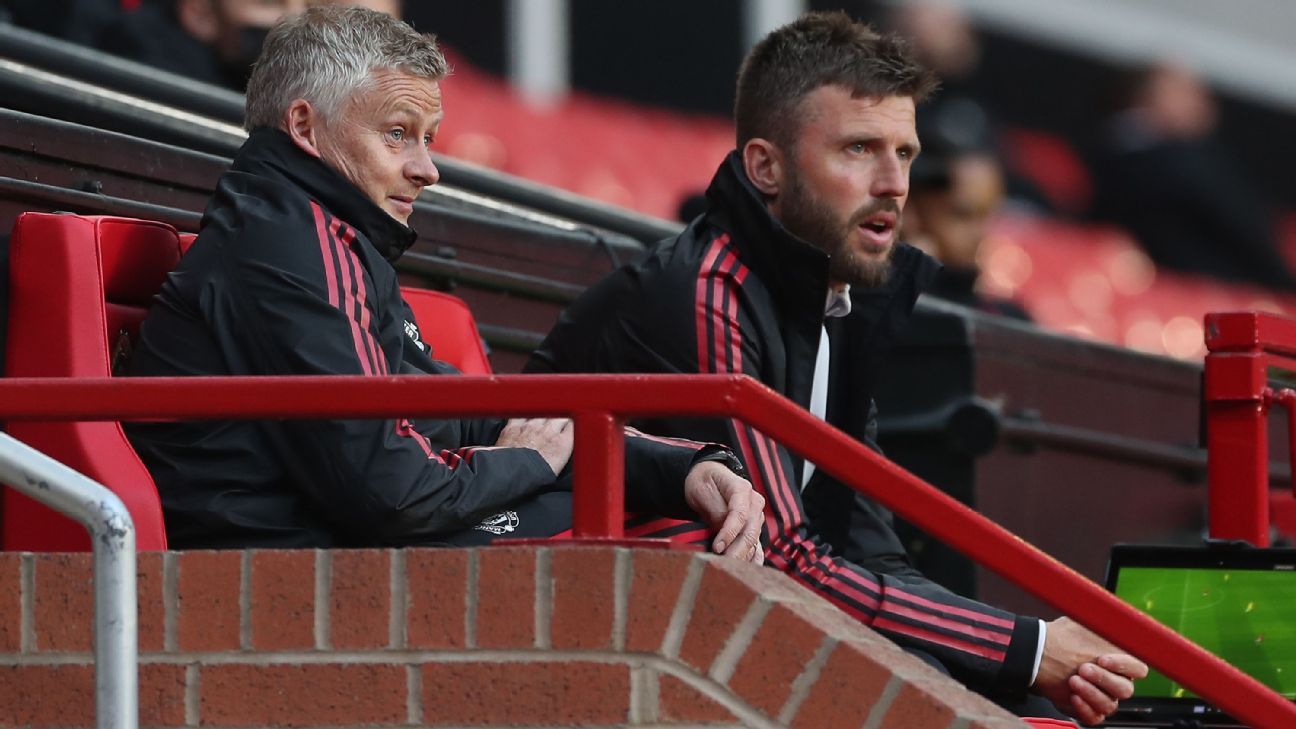
Carrick and Solskjær: Is it déjà vu at Man United again?
Gab Marcotti and Julien Laurens discuss Michael Carrick’s team selections after his great start back at Old Trafford. (2:27)


A former player returning to Manchester United to steady the ship after a roller-coaster ride under a Portuguese coach — the comparisons between the caretaker appointments of Ole Gunnar Solskjær in 2018 and Michael Carrick eight years later are obvious.
It might not end there. Solskjær took over from Jose Mourinho and did enough to win the job permanently, whereas Carrick has taken the reins from Ruben Amorim.
After Carrick began his tenure with impressive wins over Manchester City and Arsenal, there are murmurings among excited supporters that United could already have the right man in the dugout. There’s a new hierarchy these days with different voices making the big decisions. Still, the similarities between Solskjær and Carrick are hard to escape.
United have been seduced into promoting a caretaker once before, and continued success between now and the end of the season will strengthen Carrick’s case for it happening again.
– Laurens’ weekend preview: Will Spurs haunt title-chasing Man City again?
– Premier League Top 50: Ranking the best players of the season again
– ‘Hire and fire’: The exhausting job of a soccer manager in 2026
From stopgap to main man
Sources involved in hiring Solskjær in December 2018 have told ESPN the Norwegian was considered a “stopgap” when Mourinho was sacked. The plan was to buy time.
Laurent Blanc, who also had a brief stint as a player at Old Trafford, was another name in the frame to take the position temporarily, but there was a feeling internally that spells in big jobs with France and Paris Saint-Germain made it look like a long-term appointment in waiting.
Solskjær was viewed as a safer bet. He had a job at Molde to go back to in the summer of 2019 when United’s recruitment process to find a new manager was scheduled to reach its natural end. Solskjær — who had Carrick on his staff — wasn’t initially considered a front-runner for the permanent job, but, according to sources, had what was described as “option value” by United executives and wasn’t completely ruled out.
Carrick is in a similar boat. At the time of his appointment, United sources told ESPN that it would take something “exceptional” for the former England midfielder to get the job permanently and the focus, when the time was right, would center on external candidates.
The overriding message was that it was “highly unlikely” that the Solskjær situation would be repeated. Carrick — like Solskjær did — has left the door open when asked about his future. He could argue that it doesn’t get more exceptional than winning a Manchester derby against one of the greatest managers the world has ever seen in Pep Guardiola and inflicting a first home league defeat of the season on the Premier League leaders.
Going back to basics
Solskjær won his first eight games in charge, with United scoring 22 goals in the process. Sources have told ESPN that it wasn’t just the results that began to win bosses over, but the manner in which they were achieved.
Mourinho’s pragmatic style was gone, and in its place was “attacking flair, risk-taking and first-time passes going forward,” according to one source. Carrick, too, has been braver than Amorim in his early games, particularly at the Emirates when he made attacking substitutions with the game on the line in the second half.
With Solskjær, there was a sense at the time that he was helping to recover something that had been lost under Mourinho. A source told ESPN that he had “real clarification about what United needed to do to be Manchester United again. It was like talking to Sir Alex Ferguson.”
Before Mourinho was sacked, there was alarm among executives at comments he made about some of his squad players during the tour of America the previous summer. It was viewed then as the beginning of the end.
Similarly with Amorim, club bosses weren’t impressed with comments about Benjamin Sesko and Patrick Dorgu. He said Sesko was “struggling” and that Dorgu was “anxious” every time he touched the ball.
It has been noticeable that Carrick has kept news conferences shorter. He was given the chance to criticize Diogo Dalot following a poor individual performance against City, but rather than agree — as Amorim might have done — Carrick chose to defend him.
Solskjær won favor with the way he handled the media, and Carrick, too, is saying all the right things.
Off-field considerations
It wasn’t just on the pitch where Solskjær impressed. When Mourinho read reports that United wanted to hire a director of football, he angrily approached then-executive vice chairman Ed Woodward and said: “Tell me this isn’t true.”
It had long been the goal of the club to modernize the structure, but there was a feeling that it couldn’t happen while Mourinho was there. Solskjær, according to one source, was more open-minded and considered himself a “hand in a glove” rather than a dictator.
With Solskjær in charge, United were able to appoint their first football director and technical director in March 2021. One source told ESPN that it was “easier to move forward” without Mourinho in charge.
There will be similar considerations this time. Amorim eventually rebelled against the club’s structure, and his spectacular fallout with the director of football Jason Wilcox contributed to his departure.
But rather than amend the distribution of authority in the wake of Amorim’s sacking, United are doubling down and insist that the next permanent manager will have to accept his place within the decision-making process.
Other external candidates like Thomas Tuchel and Roberto De Zerbi have shown in the past that they can be very demanding, particularly when it comes to recruitment. Given how the relationship with Amorim ended, you can understand why a more understated, accommodating character like Carrick would be appealing to Wilcox and CEO Omar Berrada.
History repeating?
In the end, above everything else, it’s the results that matter most. Solskjær won 14 of his 19 games as caretaker and was appointed permanent boss in March 2019.
“Since coming in as caretaker manager in December, the results Ole has delivered speak for themselves,” Woodward said at the time.
Sources have told ESPN that there was “no defining moment” when bosses decided Solskjær was the right man. It helped that in January 2019, Solskjær took his team to Tottenham — managed by Mauricio Pochettino, the leading external candidate for the United job — and won 1-0.
“We talked about doing a process, but it turns out we didn’t need to. He showed the right things on and off the field from the get-go,” said one source.
United, as things stand, still plan to push ahead with their search. They’ve talked about waiting for a manager currently preparing for the World Cup — someone like Tuchel, Pochettino, Carlo Ancelotti or Julian Nagelsmann.
There are also contenders with Premier League experience like Andoni Iraola, Marco Silva and Oliver Glasner. One thing in particular that Wilcox and Berrada are looking for is the ability to handle the pressure that comes with managing United, especially because a key part of the job is teaching players to do the same.
There was a sense that it became too much for Amorim, and United do not want to make the same mistake again. It’s one of the things that set Solskjær apart in 2019. It could yet do the same for Carrick.
Both learned to deal with the intense spotlight and unique scrutiny at Old Trafford as players, each winning multiple league titles and the UEFA Champions League. They’ve both been there, seen it and done it.
So far, United have been keen to distance themselves from suggestions that history could repeat itself. A few more good results and the noise might become impossible to ignore.
Leave a Reply